



The power of AI in a DAM
13. November 2023
What AI in DAM actually delivers today – explained simply and straight from real-world practice.
More

by Veronika Altenbach

A large portion of the information on an asset is rarely found in the filename or in classic metadata (IPTC, EXIF, XMP, etc.) within the image itself. Which colors dominate a product photo, what exactly is seen in the image, a seal in the corner of a package, or a slogan above an advertising motif? All of this carries meaning that can hardly be systematically captured with conventional tagging in the DAM. Yet it is precisely these details that often determine whether an asset is even relevant for a particular campaign, market, or review.
With specifically developed AI prompts within the DAM system, assets can be automatically analyzed for precisely such features, and the results can be stored directly on the asset as searchable metadata. Depending on the use case, only the stored prompt differs, not the underlying logic: analyze the image, check against a defined structure, return the result in a structured manner, and store it.
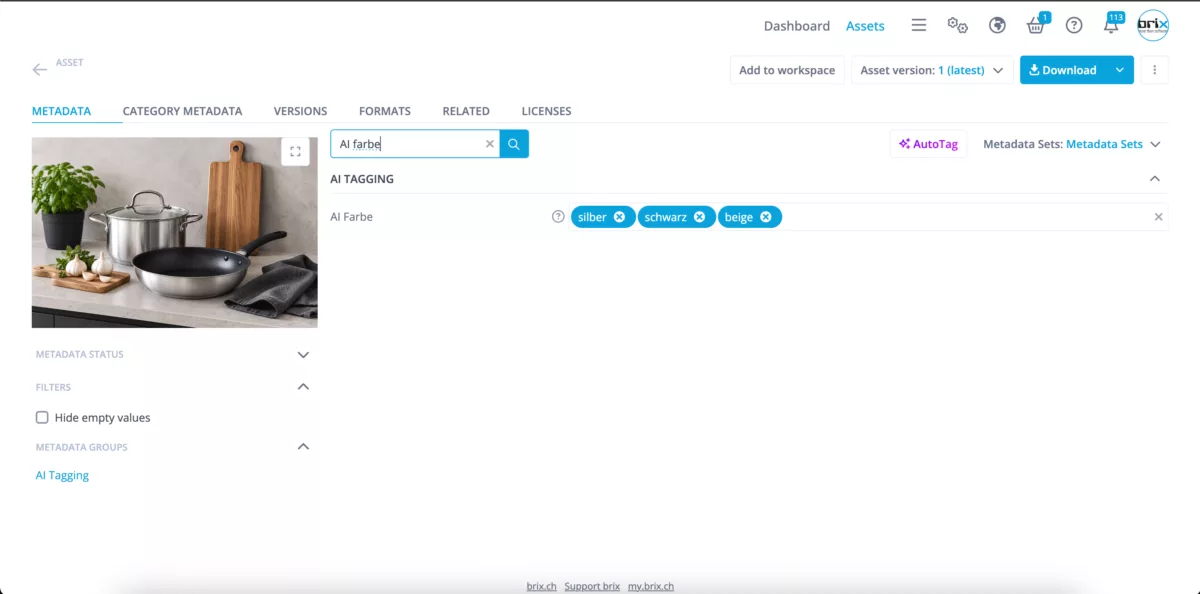
For many applications, it is not enough to capture all the colors present in the image – visually dominant ones are required. A corresponding prompt selects one to three colors from a predefined taxonomy (e.g., black, white, red, blue, gold, multicolor) and ignores small details like logos or reflections unless they are dominant themselves. Similar shades are deliberately grouped together – navy blue and light blue, for example, are uniformly classified as «blue». The result makes assets filterable by color scheme, without any manual color tagging.

AI-generated image
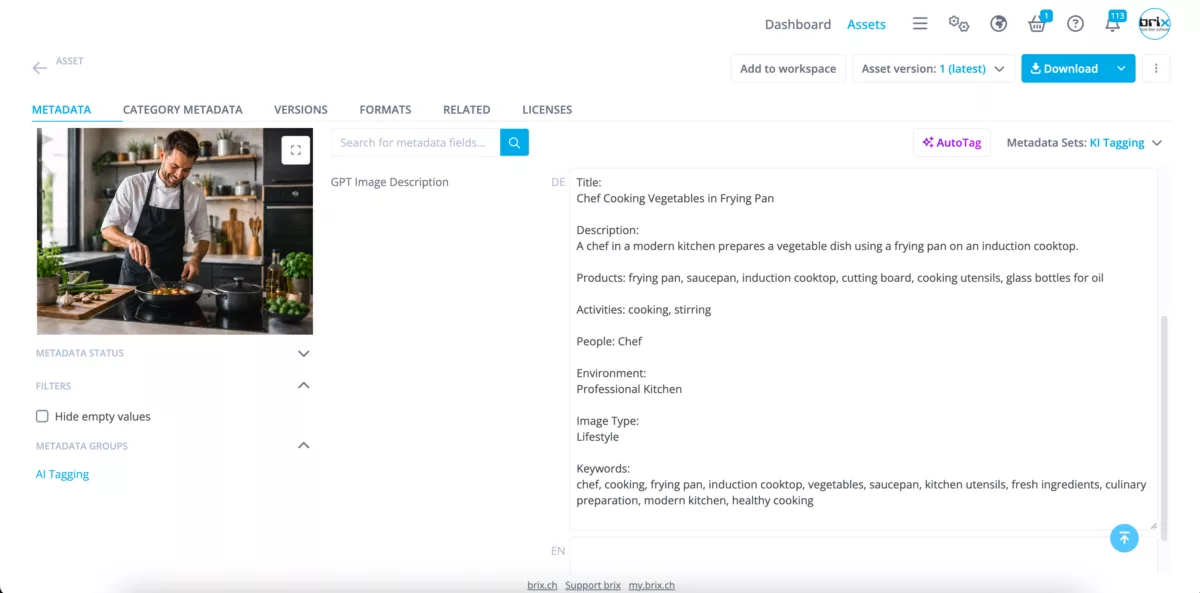
A second use case generates complete metadata from the image content itself: title, description, visible products, activities, person roles, and environment. A crucial factor is an additional company context in the prompt – for example, the information that a company manufactures kitchen appliances. This context directs the AI to recognize relevant terms (such as «pan», «pot») and to describe people solely by role («chef», «customer») instead of identifying them. This results in complete, consistent metadata on product, activity, environment, and image type – captured automatically instead of manually.

AI-generated image
Image Description
A field where this analysis saves a lot of time is environmental claims concerning the EU Green Claims Directive and similar regulations. A specially developed prompt checks assets for statements about the environment and sustainability, climate and CO₂, recycling, packaging, biodegradability, natural origin, and energy efficiency.
Important: The AI does not make a final legal assessment and does not grant approval. It creates a structured compliance pre-assessment and indicates which assets should be further examined by marketing, regulatory, or legal teams.
The risk level indicates how urgently a claim should be examined:
This does not replace a legal assessment – the level only helps to prioritize the order of examination.
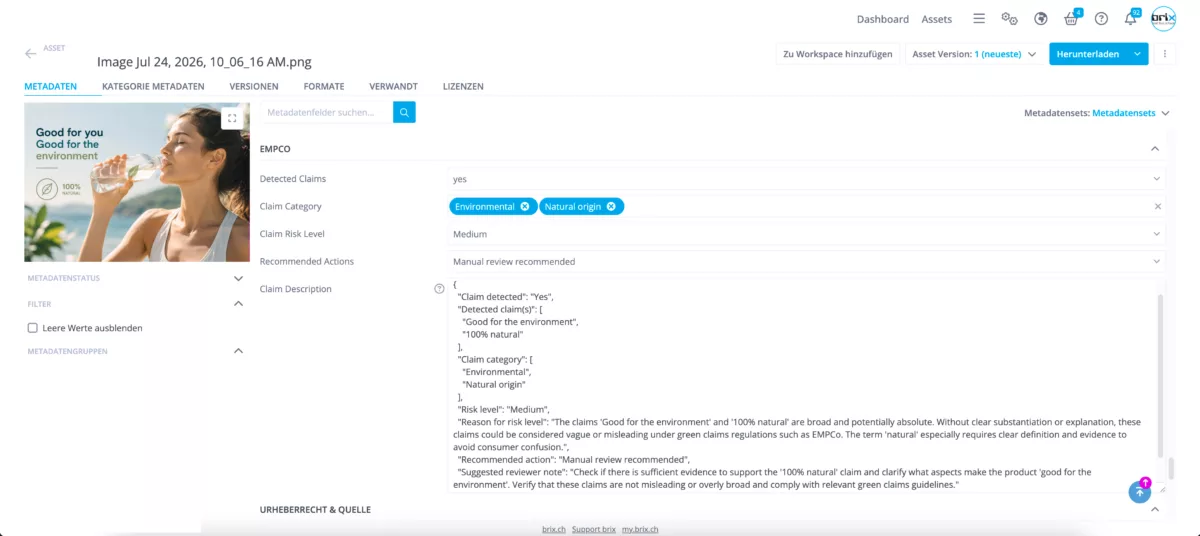
The water bottle. An advertising motif shows a person drinking from a bottle, complemented by the statements «Good for you. Good for the environment.» and «100% natural.» The statement «good for the environment» remains vague – it does not specify any concrete aspect of the product or packaging:

AI-generated image
The Water Bottle:
The AI provides a structured result:
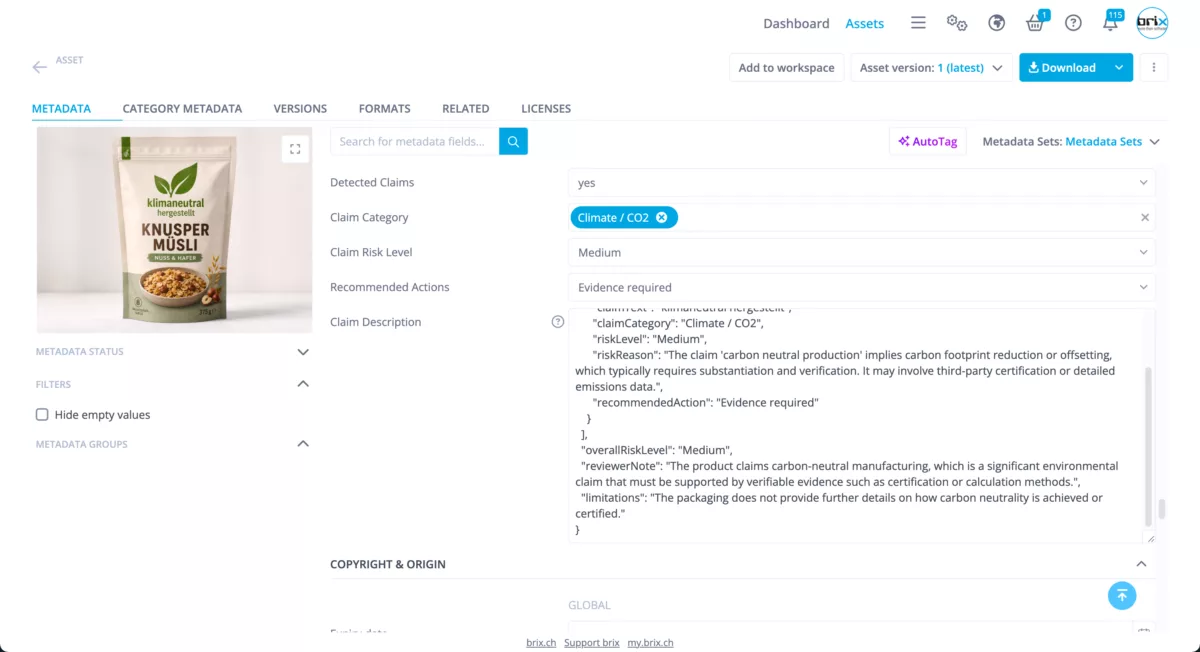
The packaging. A product photo shows food packaging with a stylized leaf symbol and the note «climate-neutral produced». Here, the claim is created only from the combination of icon and short text – a signal that a purely text-based review often overlooks:
The packaging:
The AI provides a structured result:
What this means: Whether it's dominant color, image content, or green claim – the underlying analysis logic remains identical, only the stored prompt and the searched categories change. For example, it is conceivable to recognize people in the image to control consent and image rights workflows – relevant wherever assets with recognizable people may only be used with valid approval. Brand compliance checks or automated alt-text generation for accessibility are also possible. A company can thus add additional features with manageable effort as soon as a new need arises, without having to rebuild the analysis logic.
The analysis results are stored directly on the respective asset as metadata – including, depending on the application, color values, structured image descriptions, or «Claim Category» and «Risk Level».
The basic requirement is not specific software but two technical components:
If the DAM system does not yet have this capability, it could be connected in the future via an additional service. For example, in Sharedien, the prompt can already be directly embedded in the configuration of the metadata fields, so it is automatically applied.
Because the results are available as metadata, affected assets can be searched, filtered, and specifically transferred into review or campaign processes across the organization.
How much time the automated analysis saves compared to manual tagging depends on how many assets are analyzed, how incomplete the previous tagging is, and how many features per asset are to be recorded. There is no general number for this.
This creates a common foundation for marketing, sustainability, regulatory, and legal – for early identification of relevant assets, traceable review processes, and more efficient preparation for regulatory requirements such as EmpCo.
Whether it's color schemes, image content, or green claims: Relevant information is often hidden in details that classic tagging does not capture. A specifically developed AI prompt makes these details visible and searchable – serving as a structured, prioritized starting point for the responsible teams.
Would you like to know if and how AI-supported image analysis can be integrated into your existing system? We help you define the right prompts.
Talk to us – we will show you how AI classification can be integrated into your existing DAM structure.
No. The AI exclusively creates a structured compliance pre-assessment and marks potentially relevant assets. A final legal assessment remains the responsibility of regulatory or legal teams.
No. However, prerequisites are that the DAM system allows for or provides an AI connection to analyze images, and information fields where the results can be stored in a structured manner. Many DAM systems now offer this combination out-of-the-box – for example, Sharedien from our own portfolio.
It cannot be quantified across the board, as it strongly depends on the size of the inventory and the tagging effort so far. However, the structural effect remains the same: instead of reviewing each asset individually, teams only check the hits marked by the AI.
Yes. The underlying analysis logic remains the same for each use case, only the stored prompt and the categories being searched for change. Possible applications include brand compliance checks, automated alt-text generation, or the identification of individuals for consent workflows.
Depending on the category, different teams are required: For Green Claims, typically Marketing, Regulatory, or Legal, for other features, such as Brand Management or Campaign Managers. The AI provides a prioritized starting point, not a final decision.
What AI in DAM actually delivers today – explained simply and straight from real-world practice.
More
AI agents in DAM promise autonomy. Where they truly deliver value today – and why structure is essential – is what this article explores.
More
Increasing data volumes and new customer demands require efficient content management. DAM systems support companies in various areas to increase productivity. Find out more!
More