

DAM vs. DMS – two solutions for more consistency and productivity
11. August 2022
What are the key differences between a Document Management System (DMS) and a Digital Asset Management (DAM) system?

by Veronika Altenbach
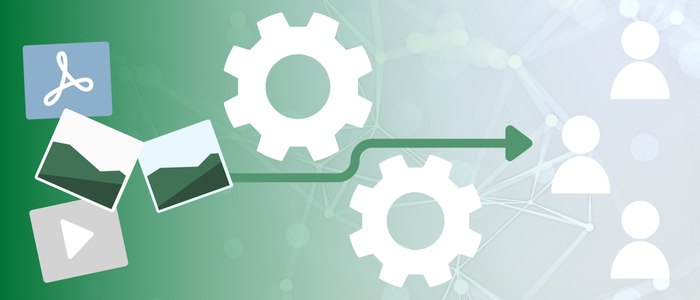
An asset – meaning a digital media file such as an image, video, or document – is considered approved once it has the required metadata, has passed the organization's defined approval workflow, and is marked as final in the DAM. But that doesn't mean it has reached the place where it's actually needed – the channels that will use it. Between «approved» and «ready to use» lies a step that receives surprisingly little attention in most DAM projects: asset delivery.
Structure, search, and approval naturally receive a great deal of attention during implementation – and rightly so. Without solid Digital Asset Management fundamentals – the centralized management of digital media assets – no one can reliably find the right content. The real bottleneck, however, often appears at the very end of the process. Every channel requires its format – for example, WebP in multiple sizes for the web, CMYK files with bleed for print production, or a 4:5 aspect ratio for social media. If the DAM cannot generate these automatically – or could, but hasn't been configured accordingly – someone ends up exporting and preparing the files manually.
That is the point where it becomes clear whether a DAM is truly saving time and resources – or simply serving as an expensive file repository.
Approval is a status within the system. Delivery is the movement of an asset beyond the DAM – to the people and systems that need it, in the right format, through the right channel, and under the right conditions.
This step is often overlooked when selecting a DAM because its impact only becomes apparent in day-to-day operations – when the first channels request assets and manual exports start becoming part of the routine.
The first key factor is renditions – alternative versions of an asset generated from a single original. Size, resolution, color space – such as RGB for screens or CMYK for print – and crop can all be defined through rules, allowing one uploaded master file to be automatically transformed into every required output format: a transparent PNG for an online store, a PDF/A – the standardized format for long-term archival – for compliant document storage, or a lower-resolution version for digital signage, such as advertising displays or public information screens, without anyone having to repeat these steps manually.
This does more than reduce effort. It also minimizes the risk of errors. Manual exports inevitably lead to someone forgetting a required size or using an outdated source file. Automatically generated renditions, by contrast, remain consistent with the original asset – even when that original is updated later.
When a channel requests a format that hasn't yet been defined, you simply create a new rendition rule once. From then on, every new original asset is processed automatically according to that rule, with no additional setup required.
Some DAM platforms already go a step further. Instead of defining rendition rules in advance, parameters such as size, crop, or file format can be passed directly in the delivery URL. The required rendition is then generated on demand; currently, it is requested without any prior configuration. Bynder and Sharedien refer to this as «Dynamic Asset Transformation (DAT)», while DAMlivery offers the same capability through «Signed URLs». For image delivery, this approach is already widely used today.
The second factor is not the file format but how the asset gets there. Even today, many teams still distribute assets by creating copies: a ZIP file sent by email, a download link via services such as WeTransfer, or a message with an attachment. Each of these copies is then stored again – on a local drive, in an inbox, or in another storage system – resulting in the same asset being duplicated multiple times instead of being managed from a single source of truth.
The problem rarely becomes obvious right away. It only surfaces when the original asset is updated or corrected. Suddenly, multiple versions are circulating at the same time, no one is certain which one is current, and often it's no longer even possible to determine where the original file is – or whether it still exists at all.
CELUM ContentHub addresses this problem at its source. Instead of sending copies, each channel retrieves the asset directly from the DAM – much like streaming services, where everyone accesses the same up-to-date version instead of sharing downloaded files. The technical approach depends on the target channel:
Links, APIs, or CDN delivery – the simplest approach: Web CMS platforms, social media publishing tools, or print systems retrieve assets directly from the DAM using a public URL. When the original asset is updated, the delivered version updates automatically as well. Most DAM platforms support this through public asset URLs. CELUM and pixx.io, for example, provide their CDN capabilities, while Bynder and Sharedien additionally support dynamic transformations directly through the URL.
For organizations managing many channels and output formats, we recommend DAMlivery by DAM United. The original asset remains in one central location, while DAMlivery automatically delivers the appropriate size, crop, and file format for every request through a unique URL. It can also act as the origin server for an existing CDN. For a major Swiss wholesaler with more than 25,000 products, we implemented this approach to provide product images for both the web shop and mobile app. Facing a similar challenge?
Talk to us about your requirements.
Depending on the integration method, the system may deliver, distribute, or synchronize assets – but in every case, the DAM remains the single source of truth.
Implementation effort varies accordingly. Public URL and API-based delivery are standard features in most DAM platforms, whereas connector integrations and syndication typically require dedicated integration projects and additional configuration. For many common business systems, however, the implementation effort is lower than expected. The brix Marketplace already offers a wide range of ready-to-use connectors for integrating other systems. And if the connector you need isn't available yet, we can develop it for you – just contact us.
The third factor is also the easiest to overlook: usage rights don't end when an asset is approved in the DAM. They must remain attached to the asset all the way to its actual use. An image with a time-limited license may have long since been approved internally but can still end up being used where it's no longer permitted – simply because the receiving channel isn't aware that the license has expired. Beyond expiration dates, usage may also be restricted by country or channel limitations, embargo periods before a product launch, or a withdrawn model release.
Digital Rights Management (DRM) ensures that usage conditions travel with the asset all the way to the point of delivery. When usage rights expire – whether due to a license expiration, an embargo, or a revoked permission – the system automatically prevents further delivery instead of relying on manual checks by individual users.
How effective this is depends on the delivery method. With URL-based delivery – such as public asset URLs, Dynamic Asset Transformation in Bynder and Sharedien, or DAMlivery – the asset becomes instantly unavailable across all connected channels. In contrast, previously exported copies continue to exist independently. Advance notifications alert users before licenses expire, allowing action to be taken before distribution is interrupted – an important safeguard for organizations managing numerous channels and frequently changing image licenses.
A DAM that only addresses structure, search, and approval solves only half the challenge. The other half is decided at the point of delivery – getting the right asset, in the right format, to the right channel, automatically instead of manually. Organizations that plan for this from the start turn their DAM into a system that delivers real efficiency gains.
Contact us for a consultation. We'll show you whether – and how – these three factors can be implemented with your current DAM platform and where there is still potential for optimization.
In rule-based systems, a new rendition rule only needs to be defined once. After that, the system automatically generates that format for every new original asset. In systems with dynamic URL-based transformation – such as Dynamic Asset Transformation (DAT) in Bynder and Sharedien or Signed URLs in DAMlivery – even this step is unnecessary. The required format is simply requested through the URL and generated on demand at the moment of delivery.
Link- or API-based delivery is included as a standard feature in most DAM platforms, making it the best starting point in most cases. Connector integrations and syndication can then be added as your distribution needs grow and specific channels require them.
Through advance notifications configured in the DAM. These alerts notify users several days before a license expires, giving the organization time to renew the license or replace the asset before delivery is automatically stopped.
With Digital Asset Distribution, channels access assets directly from the DAM through controlled links, APIs, or connectors. A traditional file export, by contrast, creates a separate copy. If the asset later becomes invalid in the DAM – for example, because its usage rights have expired – the exported copy typically remains available and can still be used independently.
DAMlivery delivers assets directly from the DAM through a unique URL whenever they are requested, instead of exporting and storing renditions in advance. If the usage rights expire, the asset immediately becomes unavailable across all channels. A traditionally exported rendition, by contrast, continues to exist as a standalone file.
Not necessarily. Some platforms allow parameters such as size, crop, or file format to be specified directly in the delivery URL. The rendition is then generated on demand at the moment it is is requested, without any prior configuration. Bynder and Sharedien call this Dynamic Asset Transformation (DAT), while DAMlivery refers to the same capability as Signed URLs.
What are the key differences between a Document Management System (DMS) and a Digital Asset Management (DAM) system?
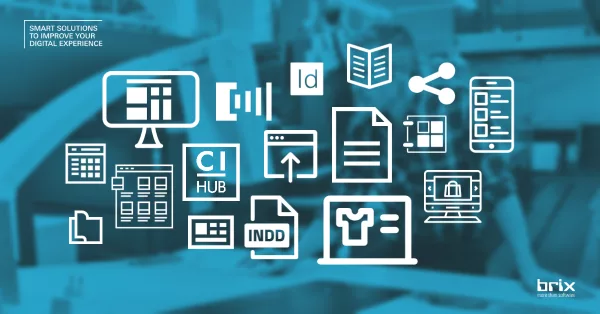
Need to create brochures, advertisements and flyers with the same basic layout but different content in Adobe InDesign in no time? Take a look at CI HUB, for easy and fast database publishing – it's worth it.
More
Learn how to build a compelling business case for acquiring a digital asset management (DAM) system. Discover the strategic need, financial implications and operational benefits. Discover the ways in which a Digital Asset Management (DAM) system can enhance productivity and propel your business towards success!