Process management in marketing - brix - Basel/Allschwil

Process management in marketing

by Kevin Lang

BPM
27. January 2026 7 minutes

Why getting started with process management in marketing often fails

PROZESSMANAGEMENT IM MARKETING

Process management is on the agenda in many companies. Marketing, communications, and content departments in particular are under a lot of pressure. More and more channels need to be served. Content needs to be published faster and coordination is increasing. At the same time, data and media stocks are constantly growing.

Getting started with process management often remains unclear.

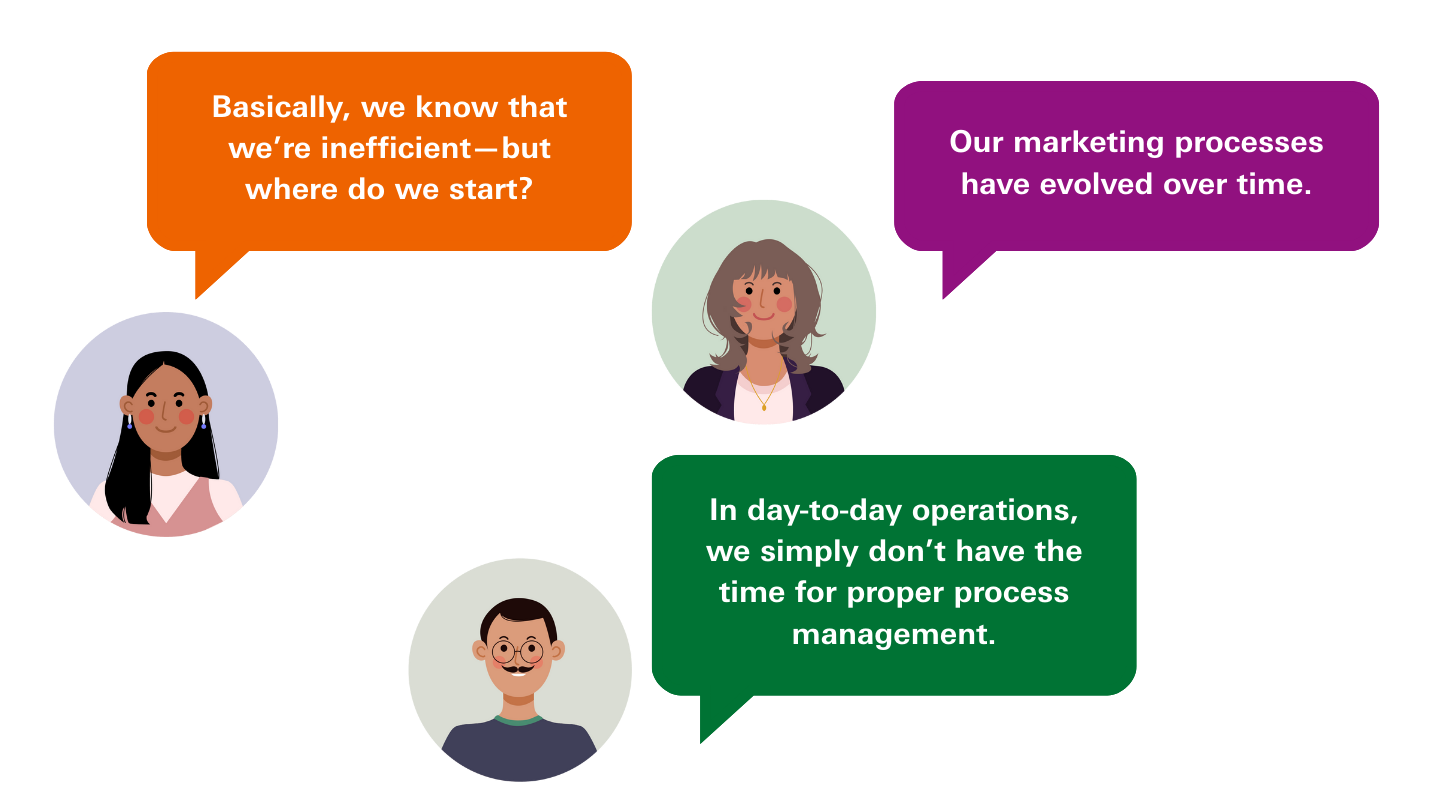
Typical statements from practice:

Our marketing processes have evolved over time.

In our experience, the main problem is not the complexity of the processes. It is the lack of a structured introduction. Process management is too often understood as a large organizational project – instead of a concrete tool to relieve the burden of day-to-day business.

What process management in marketing should really achieve

Process management has a clear purpose. It is more than just documentation. In marketing in particular, there are important questions to be answered:

  • How can campaigns be implemented more quickly and reliably?
  • How can approvals be made transparent and traceable?
  • How can we avoid duplication of work and media breaks?
  • How can we ensure that media is used consistently and correctly?

For process management to be effective, it does not require a large program, but rather a clear and traceable procedure.

In our experience, the following steps have proven successful. They help companies – especially in marketing, digital asset management, and content – get off to a good start.

1. Start with a specific marketing or content process

The best place to start with process management is where the pressure to act is high. Proven entry-level processes from marketing and digital asset management projects:

  • Creation and approval of marketing materials
  • Content production for web, social media, or print
  • Translation and localization processes
  • Asset creation, approval, and distribution via a DAM
  • Campaign coordination between marketing, product management, and sales

Our recommendation

Don't start with «We are introducing process management.»

Instead, start with: «We want to make this process clearer, more stable, and more efficient.»

2. Describe processes in an understandable way – and use modeling in a targeted manner

Especially at the beginning, the focus is on a common understanding. A process should be described in such a way that everyone involved can understand it and apply it in their everyday work.

For an initial overview, simple visualizations are often sufficient, which:

  • Describe the process and activities
  • Make roles and responsibilities visible
  • Show connections between teams and systems
  • Identify decision and approval points

Depending on the objective and complexity, it may be useful to use detailed BPMN modeling.

BPMN provides the necessary clarity and transparency, especially for cross-departmental marketing, DAM, or content processes, system-supported workflows, and the preparation of automations.

Practical experience shows that

BPMN unfolds its added value when processes are not only described but also actively controlled, further developed, and technically implemented – for example, as a basis for workflow engines, system integrations, or clear procedures and responsibilities.

Here we explain how companies can get started with process modeling – from simple representations to BPMN modeling:

A practical introduction to process modeling.

Read article now

3. Create clear responsibilities

A common stumbling block in early process management: processes are documented – but no one feels responsible for them.

This is particularly critical in marketing, where many processes are cross-functional. A clear distribution of roles is essential here, as different actors with clearly defined responsibilities work together in business process management.

Therefore, the following should be clarified early on:

  • Who is responsible for the process?
  • Who decides on adjustments and exceptions?
  • How are escalations and special cases handled?

Process management is always also organizational work. Without clear roles, even the best model will be ineffective.

4. Systematically reveal optimization potential

Once a process is transparent, weak points become clearly visible:

  • Long waiting times for approvals
  • Manual coordination via email
  • Lack of standards for content or media
  • Unclear versions and multiple storage locations
  • Media breaks between systems such as DAM, CMS, and publishing systems

Important from our experience:

Not every automation automatically creates added value. Often, clear rules, templates, or roles can already achieve significant efficiency gains. Automation makes sense when processes are stable and well thought out.

The following article explains how to sensibly evaluate and prioritize automation potential: Maximizing automation potential: Simple methods for identifying suitable processes.

Evaluating automation potential correctly

5. Combining process management and system landscape

Recurring marketing and content processes raise the question of systemic support:

Workflow-supported approvals

Versioning and traceability

  • Integration of DAM, CMS, and publishing systems
  • Clean transfers between tools and platforms

A common mistake in projects:

Systems are introduced before processes are clearly defined – or processes are modeled without taking the reality of the system into account.

Sustainable process management combines both. The success story of Ivoclar shows how processes and the system landscape can be meaningfully integrated in practice.

To the Ivoclar success story

Structured introduction to marketing, DAM, and content processes

After taking their first steps in process management, many companies find themselves at a similar point:

The important processes have been described. Weak points have been identified. Now the question is how to turn this into a consistent and repeatable process.

Practical experience shows that a clear framework is needed that sensibly combines approach, modeling depth, and system reference. Without this framework, process management often remains selective and difficult to scale.

Our BPM bundles have been designed precisely for such an introductory framework. They are based on proven approaches from marketing, DAM, and content projects and combine:

The bundles are used, among other things, for:

This approach helps to start certain processes in a structured manner. At the same time, it creates a solid basis for later expansions. This means that process management does not have to be started as a large project.

Further information on BPM bundles

Start process management pragmatically – develop it professionally

Getting started with process management does not have to be complex or tedious – especially in the marketing and content environment.

The key factors are:

  • A clear, practical starting point
  • Comprehensible processes with targeted modeling depth
  • Clear responsibilities
  • Early connection of processes, BPMN, and systems

Companies that start process management pragmatically and develop it professionally lay the foundation for efficiency, quality, and scalability in marketing.

Let's talk about your starting point

In a brief exchange, we will identify the right process for a structured start – pragmatically and without a large-scale project.

Related topics


Verschachtelte prozesse

Mastering nested processes

BPM
17. November 2025

Nested processes are part of everyday life in many organizations – and they can quickly lead to a loss of clarity. Learn which steps help make complex process landscapes visible and manageable – and why keeping an eye on the big picture is essential.

More
Einstieg in Prozessmodellierung

The practical introduction to process modeling

BPM
15. September 2025

What really happens in the process—and how do you make it visible? Learn how clear process modeling not only helps you structure workflows, but also specifically improves efficiency, transparency, and collaboration in your company.

More
Prozesslandkarte

Guide: Why every organization should use process maps

BPM
03. July 2025

Discover how a process map can help you establish structure, transparency, and clear responsibilities within your organization.

More